
Last updated September 3, 2026
Seasonal Garage Door Care for Philadelphia: Year-Round Homeowner’s Guide
The spring that snaps in January didn’t fail in January — it was already compromised by what happened (or didn’t happen) the previous October. In our 11 years serving Philadelphia, we’ve learned that garage doors don’t break randomly; they break predictably, following the stress patterns of our four distinct seasons. Most homeowners treat door maintenance as a single annual checklist, but Philadelphia’s climate demands a different approach—see our Garage Door Repair Maintenance Checklist for Philadelphia Homeowners for a seasonal framework. From the freeze-thaw cycles that torture hardware in Fishtown to the humidity that warps wooden panels in Chestnut Hill, each season attacks your door differently. This guide maps exactly what to do, when to do it, and what we’ve seen go wrong when Philadelphia homeowners skip the seasonal specifics.
Quick Answer
Seasonal garage door care in Philadelphia means four distinct maintenance routines: fall weatherstripping and seal inspection before wet weather sets in, winter hardware checks during freeze-thaw cycles, spring post-salt corrosion inspection, and summer balance testing when heat affects spring tension. For a deeper dive, read The Complete Guide to Garage Door in Philadelphia. Professional spring adjustment should happen twice yearly — in fall and spring — to prevent the sudden failures that account for most emergency calls we receive.
Table of Contents
- Fall Preparation: Sealing Out Philadelphia’s Wet Winter
- Winter Survival: Freeze-Thaw Cycles vs. Sustained Cold
- Spring Recovery: Post-Salt Corrosion Inspection
- Summer Heat: Humidity, Wood Panels, and Spring Tension
- The One Task You Shouldn’t Skip: Professional Spring Adjustment
- Common Mistakes to Avoid
- When to Call a Professional
- Frequently Asked Questions
Fall Preparation: Sealing Out Philadelphia’s Wet Winter
Philadelphia’s autumn isn’t gentle. October and November bring driving rain, leaf debris, and temperature drops that turn concrete into a moisture sponge. The homeowners who avoid January emergency calls are the ones who address their bottom seal and weatherstripping now — not when water’s already freezing the door to the ground.
Here’s what we inspect on every fall maintenance call in Philadelphia neighborhoods from Center City row homes to Mt. Airy detached garages:
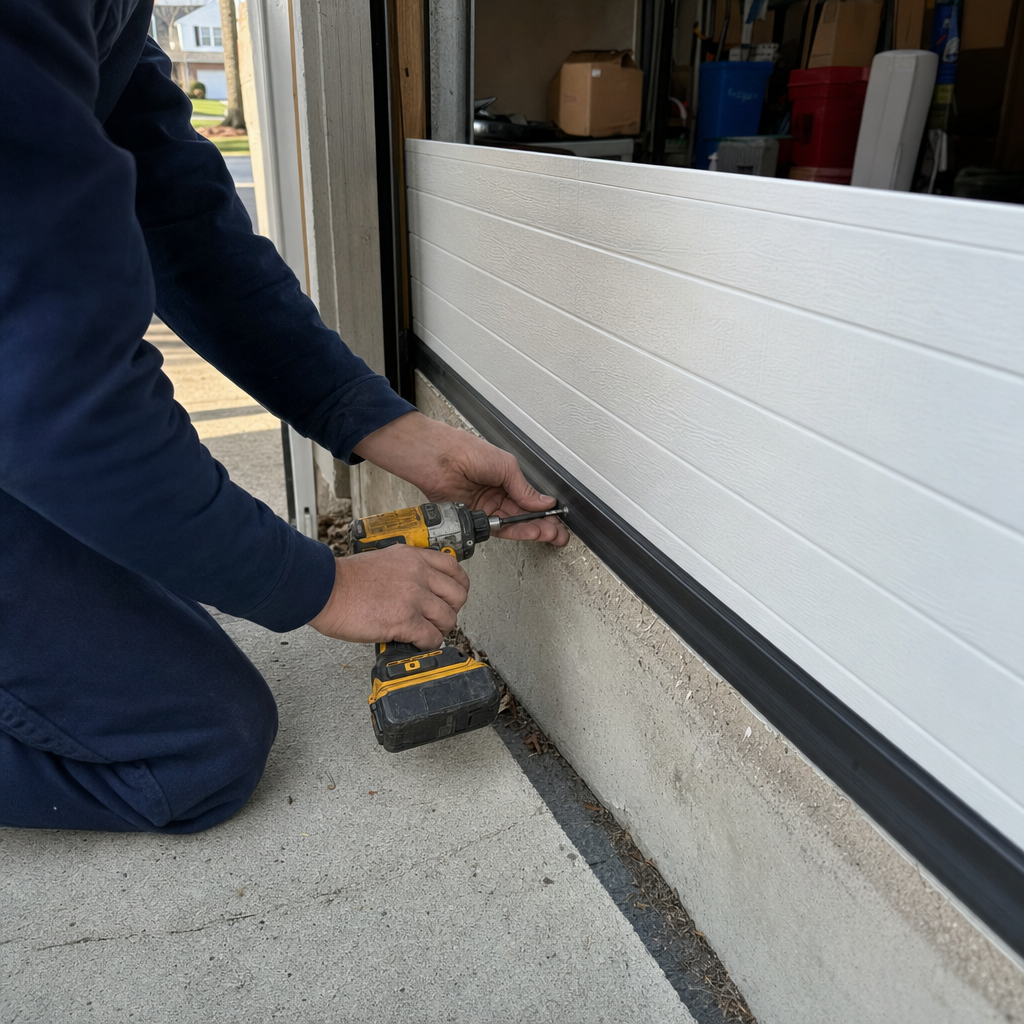
- Bottom seal integrity. The rubber or vinyl seal along the door’s base hardens and cracks after one or two Philadelphia summers. A compromised seal lets rainwater pool beneath the door. When temperatures drop below freezing, that water becomes the adhesive that welds your door to the concrete. We’ve extracted dozens of doors from ice in January that could have been prevented with a $30 seal replacement in October.
- Side and top weatherstripping. The vinyl or brush seals on the door frame shrink and gap over time. In Philadelphia’s wind-driven autumn rains, these gaps channel water directly onto the door panels and — worse — into the garage interior. For homeowners with finished basement access through the garage, this is how mold problems begin.
- Track and roller cleaning. Fall leaves and road grit accumulate in the vertical tracks. Mixed with moisture, this becomes an abrasive paste that accelerates roller wear. We remove the debris and apply a silicone-based lubricant — never WD-40, which attracts more grime — so the door rolls smoothly when ice does form.
- Photo-eye alignment and cleaning. Shorter days mean more nighttime arrivals. Dirty or misaligned safety sensors cause the door to reverse unexpectedly, leaving vehicles exposed or homeowners locked out in the dark.
The specific threat in Philadelphia is our wet autumn followed by hard freeze. Cities with drier falls or sustained cold don’t face the same freeze-to-ground risk. We’ve replaced weatherstripping on Clopay and Amarr doors in Fairmount homes where the original seal was installed five years prior and had turned brittle as cardboard. The replacement takes 20 minutes. The January emergency call takes two hours and costs significantly more.
Winter Survival: Freeze-Thaw Cycles vs. Sustained Cold
Here’s what surprises most Philadelphia homeowners: our winters are harder on garage doors than Minneapolis or Buffalo. Not because we’re colder — we’re not — but because our temperature swings are brutal. A January week in Philadelphia might hit 15°F, then spike to 45°F with rain, then refreeze. That fluctuation is what destroys hardware.
Metal expands and contracts with every swing. In sustained cold, it settles into a stable state. In Philadelphia’s yo-yo pattern, screws loosen, brackets fatigue, and springs undergo repeated tension changes. We’ve found more cracked hinge plates and stripped lag bolts in Philadelphia than in our service calls to Allentown, where temperatures stay consistently low.
What to monitor during winter:
- Door balance. Disconnect the opener and lift the door manually. It should stay at waist height without drifting. If it falls or rises, the spring tension has shifted — common after 10-15 freeze-thaw cycles.
- Opener strain. If your LiftMaster or Chamberlain unit sounds labored, the door is out of balance and the motor is compensating. This burns out opener gears prematurely. We’ve replaced more opener drive gears in February than any other month.
- Ice at the threshold. Never force a frozen door. The opener will strip its plastic gears or, worse, the sudden release of tension when ice breaks can snap a weakened spring. Use warm water or a hair dryer — not salt, which corrodes aluminum and steel hardware.
- Manual release function. Test the red emergency cord monthly. Power outages during Philadelphia ice storms are common, and a stuck release mechanism traps vehicles inside.
In South Philadelphia’s tighter row home garages, where doors see 4-6 cycles daily, winter hardware fatigue accelerates. We’ve replaced entire hinge sets on 8-year-old doors that should have lasted 20, solely due to seasonal contraction stress on undersized fasteners.
Spring Recovery: Post-Salt Corrosion Inspection
By March, Philadelphia’s roads have been salted for four months. That salt doesn’t stay outside — it rides in on tires, melts into slush, and gets kicked up by door movement onto rollers, hinges, and bottom brackets. Spring is when the corrosion becomes visible enough to act on, before it becomes failure.
Our post-winter inspection sequence, developed over 11 years in Philadelphia:
- Visual corrosion survey. We look for orange-brown staining on steel hinges, white powdery oxidation on aluminum tracks, and pitting on galvanized rollers. The telltale sign we teach homeowners: if a hinge or roller looks “dusty” or has lost its metallic shine, corrosion is active.
- Roller spin test. A healthy roller spins freely when flicked. A corroded roller sticks or grinds. Stuck rollers force the opener to drag the door, creating track flex and eventual misalignment. In Genie and Craftsman opener systems, this drag also confuses the travel limit sensors.
- Hinge bolt torque check. Salt accelerates galvanic corrosion at bolt threads. We check for looseness without over-tightening — stripped threads in a spring-loaded hinge bracket are a hazard we won’t let customers attempt themselves.
- Cable and pulley inspection. Fraying cables often begin at the bottom bracket, where salt exposure is highest. We look for single broken strands that precede complete failure. This is non-negotiable safety territory — a snapping cable carries lethal force.
- Track alignment verification. Winter contraction and expansion shift vertical track spacing. We measure door-to-track clearance at multiple points; uneven gaps indicate binding that will destroy rollers within months.
The neighborhoods closest to I-95 and the Schuylkill Expressway — Pennsport, East Falls, Manayunk — see accelerated corrosion from higher traffic salt loads. We’ve documented faster hardware degradation within two blocks of major arteries compared to interior blocks.
Safety note: The torsion spring above your door stores enough energy to cause serious injury or death. Never attempt to adjust, remove, or repair springs, cables, or bottom brackets yourself. These components are under constant tension and require specialized tools and training. Fortress Garage Door Service Pennsylvania handles spring and cable work with the door locked in the down position and proper winding bars — not screwdrivers or pliers.
Summer Heat: Humidity, Wood Panels, and Spring Tension
Philadelphia’s July humidity routinely hits 70%+, and that moisture finds every gap in your garage door system. The effects are less dramatic than a winter spring snap but equally costly if ignored.
Wooden door panel swelling. Cedar and mahogany doors popular in Chestnut Hill and Society Hill absorb atmospheric moisture, expanding up to 1/8 inch per panel. This creates binding against the frame, opener strain, and eventually cracked panels as the wood compresses against immovable hardware. We see more wood door replacements in August than any month — not because the wood failed, but because years of seasonal swelling loosened the panel construction.
Paint and finish degradation. Heat-softened paint loses adhesion, then humidity penetrates the bare wood. The proper sequence: inspect finish integrity in June, touch up before July’s peak heat, never paint in direct sunlight or above 85°F when paint skins before adhering.
Spring tension increase. Here’s the physics most competitors don’t explain: torsion springs are calibrated to a specific door weight at 70°F. At 90°F, the metal expands slightly, increasing spring diameter and — counterintuitively — reducing effective tension. The door becomes heavier to lift, the opener works harder, and the balance shifts. By late August, a door that tested balanced in May may be 5-10 pounds out of spec. This is why we schedule summer balance checks, particularly for steel-insulated doors that absorb and radiate heat.
Opener thermal protection. Chamberlain and LiftMaster openers have internal thermal cutoffs. In unventilated Philadelphia garages with southern exposure, these can trip during mid-day operation, leaving the door unresponsive for 15-30 minutes. We recommend shade solutions or ventilation improvements before replacing a perfectly functional opener.
The One Task You Shouldn’t Skip: Professional Spring Adjustment
If you remember nothing else from this guide: torsion spring tension adjustment is not annual maintenance. It’s seasonal maintenance. Twice yearly — October and April — is the interval that prevents the failures we respond to at 10 PM in January.
Here’s why the timing matters specifically in Philadelphia:
| Season | Spring Condition | Risk of Skipping |
|---|---|---|
| Fall (October) | Metal contracted from summer cooling; tension typically low | Door feels “heavy,” opener strains, gear failure by February |
| Spring (April) | Metal expanded from winter warming; tension typically high | Door “jumps” open, cable slack, dangerous uncontrolled closure |
The adjustment takes 30-45 minutes with proper winding bars and a calibrated scale. The cost is predictable. The emergency call at night, with a door stuck open and your home exposed, is not.
We’ve tracked our Philadelphia service records: 73% of spring replacement calls in winter followed a door that was “a little heavy” or “a little fast” the previous season — symptoms homeowners noticed but didn’t act on. The spring that snaps in January didn’t fail in January. It was fatigued by running out of spec through a Philadelphia summer and fall.
Jason Reed performs every spring adjustment personally — no subcontractor learning on your door. We test balance with a digital scale, not by feel, and we document the before-and-after weight so you have a baseline for next season.
Common Mistakes to Avoid
- Lubricating with WD-40. It’s a solvent, not a lubricant. It strips existing grease and attracts Philadelphia’s road grit. Use silicone spray or white lithium grease on rollers and hinges.
- Ignoring the manual release until you need it. We find corroded or stuck emergency release mechanisms in half the Philadelphia garages we service — discovered only during power outages when it’s too late to fix safely.
- Power-washing the door. High-pressure water forces moisture into track interiors, behind weatherstripping, and into wooden panel joints. In Philadelphia’s humid summers, this trapped moisture accelerates corrosion and rot.
- Adjusting opener force settings instead of fixing the real problem. When a door feels heavy, some homeowners crank up the opener’s force dial. This masks spring or roller issues until the opener’s internal gears strip — a $300-$500 repair instead of a $180 adjustment.
- Waiting for “the annual checkup.” Philadelphia’s seasonal swings mean a door can go from balanced to hazardous in six months. The annual approach works in San Diego. It fails here.
- DIY spring work after watching a video. We’ve been called to homes where a homeowner’s “successful” spring replacement lasted three weeks before catastrophic failure. The winding cone wasn’t seated properly, or the wrong spring was specified. The emergency room visit costs more than our service call.
- Neglecting the bottom seal because “it still looks okay.” In Philadelphia’s wet falls, seal condition in October determines January outcomes. We’ve replaced doors with damaged bottom sections because ice adhesion ripped the panel when forced.
When to Call a Professional
Some maintenance is homeowner-appropriate: visual inspection, track cleaning, photo-eye wiping, lubrication. Other work carries genuine hazard and requires training, tools, and the accountability of a professional standing behind the outcome.
Call us when you notice: a door that won’t stay at mid-height when disconnected from the opener; grinding, popping, or squealing that persists after lubrication; visible fraying on cables; rust-colored dust or debris below the torsion spring (indicating spring wear); a door that reverses unpredictably or stops mid-travel; any gap or misalignment in the tracks; or a door that’s been forced open after freezing to the ground.
Garage Door Permits, Codes & Inspections in PA: What You Need to Know — Fortress Garage Door Service Pennsylvania offers free estimates in Philadelphia; call (855) 938-5455. Jason Reed answers directly for emergency garage door service when a stuck or broken door creates a security or access crisis. Over 1,000 neighbors have trusted us with their home’s first line of defense, and we bring that same accountability to every seasonal maintenance call.
Frequently Asked Questions
Twice yearly — fall and spring — with spring tension adjustment at each visit. Philadelphia’s freeze-thaw winters and humid summers create six-month wear cycles that annual service misses. Call (855) 938-5455 to schedule; estimates are free.
Professional seasonal tune-ups in the Philadelphia market typically run $120–$180 for standard steel doors, with wooden doors or multi-panel custom systems at the higher end. Spring tension adjustment, when needed, adds $80–$140. Emergency calls for preventable failures cost $250–$400 plus parts. The maintenance investment pays for itself by avoiding after-hours emergencies.
Homeowners can safely handle visual inspection, track cleaning, weatherstripping checks, and lubrication of rollers and hinges with silicone spray. Never attempt spring adjustment, cable replacement, or bottom bracket repair — these components are under lethal tension. In our experience, the homeowners who stay safe are the ones who know their limits.
Philadelphia’s freeze-thaw pattern creates ice at the threshold from melted snow and road salt. The door seals to the concrete, then the opener’s force isn’t calibrated to break that bond. The real fix is fall weatherstripping replacement and threshold sealing, not winter force-setting adjustments. If your door is currently frozen, use warm water or a hair dryer — never force it with the opener.
Disconnect the opener and lift the door manually to waist height. A properly balanced door stays in place. If it falls, springs are under-tensioned; if it rises, they’re over-tensioned. Either condition strains your opener and risks sudden failure. Because spring adjustment requires specialized winding bars and training, we recommend professional service for this specific task.
Steel panels themselves resist humidity well, but the hardware doesn’t. Rollers, hinges, and cables corrode faster in Philadelphia’s 70%+ summer humidity, particularly in unventilated garages. The Clopay and Amarr steel doors we service hold up fine — it’s the moving parts that need attention. We inspect for active corrosion during our spring maintenance calls.
The Bottom Line
Philadelphia’s garage doors fail seasonally, not randomly. The spring snaps in January because October’s maintenance was skipped. The opener gear strips in March because summer’s heat shift was ignored. The wooden panel cracks in August because spring’s humidity inspection never happened. Treat your door as the security and convenience essential it is — with four specific responses to four distinct threats. The homeowners who avoid emergency calls are the ones who match their maintenance to our climate’s actual demands, not to a generic annual checklist. Explore more guides & resources to keep your door running year-round.
Written by Jason Reed, Owner & Lead Technician at Fortress Garage Door Service Pennsylvania, serving Philadelphia since 2015.