
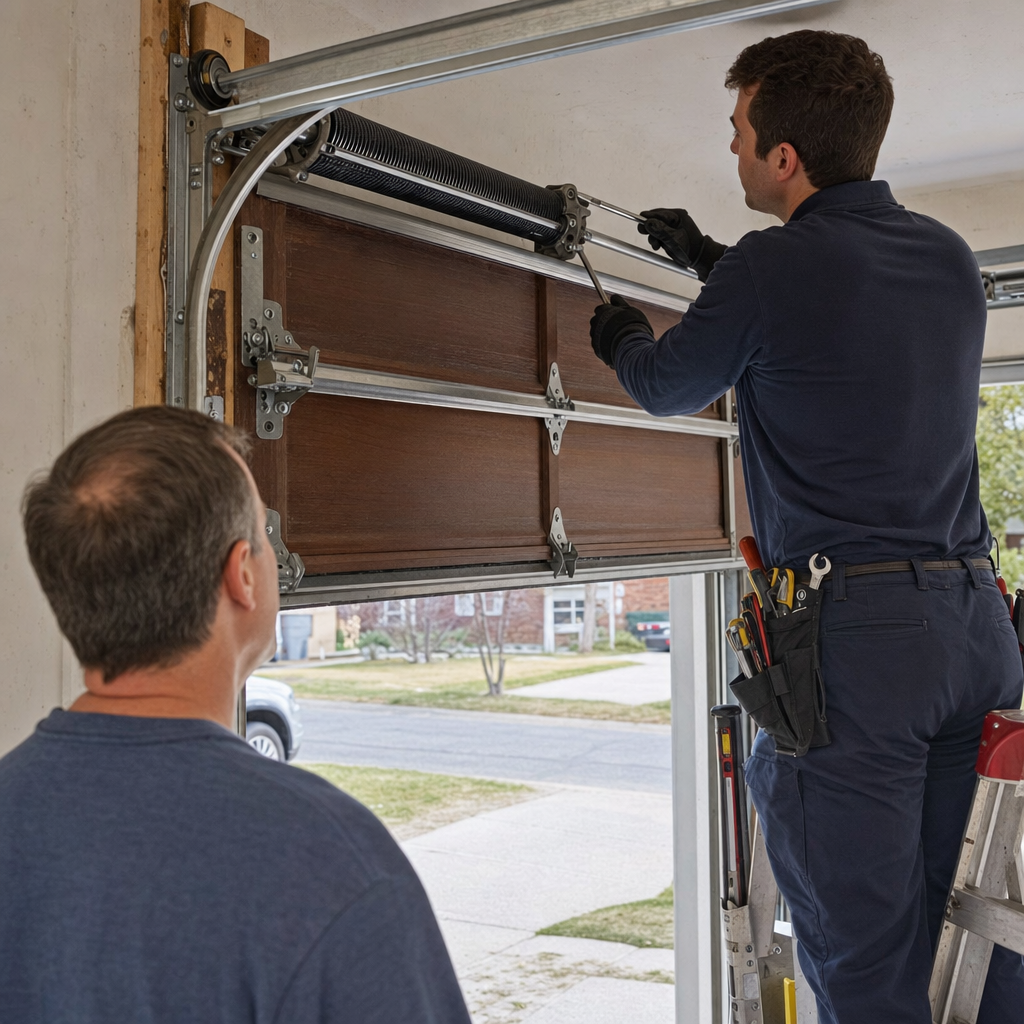
Garage Door Opener Installation in Pennsylvania: What Your Garage Can Actually Fit
Garage Door Opener Near Me in Pennsylvania, PA — typical installation costs $250–$550 and should include proper clearance measurement, drive-type matching, and safety reversal testing. Call (855) 938-5455 for a free estimate — we’ll measure your space before you buy anything. We’ve unboxed brand-new openers that went straight back in the box because the garage had 2 inches less clearance than the model required. The opener wasn’t wrong. The fit was.
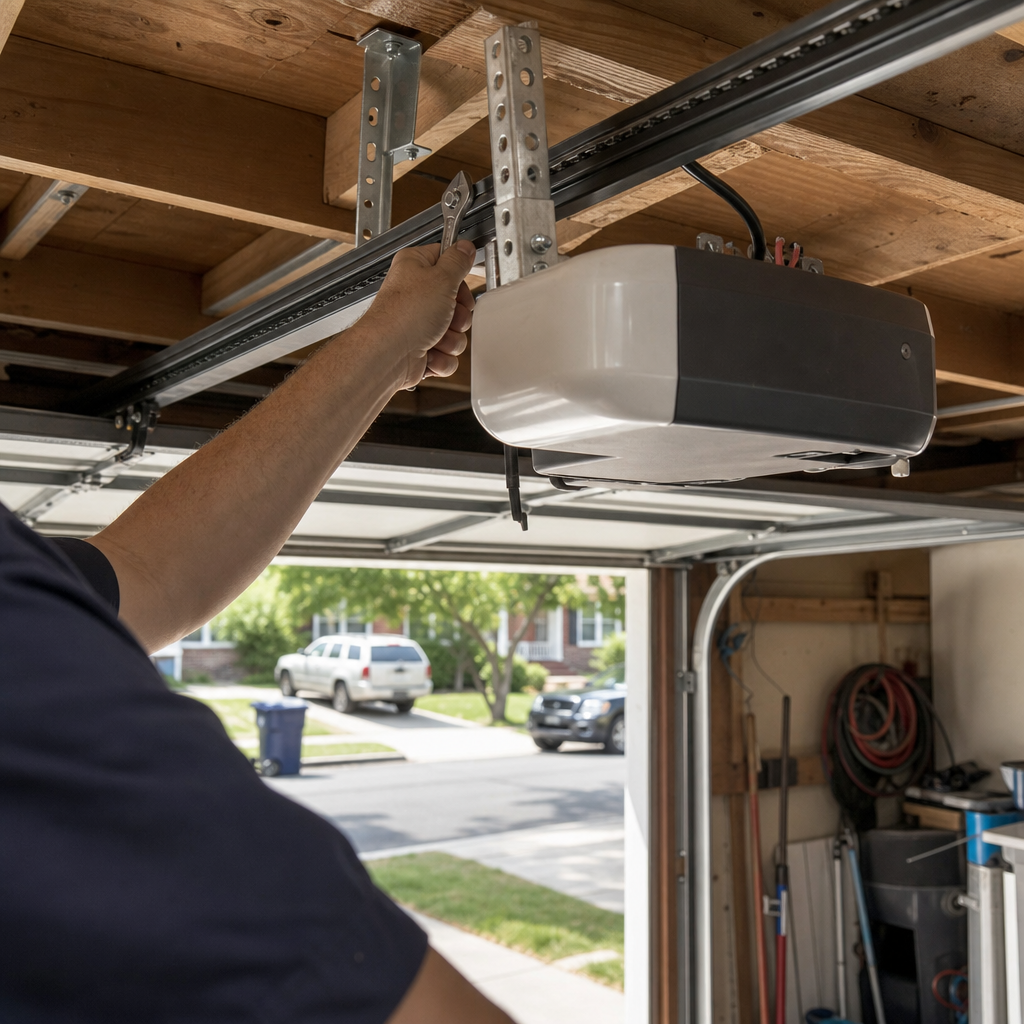
The Pennsylvania Garage Reality: Older Stock, Tighter Spaces
Pennsylvania’s housing stock skews older than the national average, and that matters more than most people realize when they’re staring at opener reviews on a Saturday night. We’ve worked on attached garages in Drexel Hill built in the 1950s with ceiling clearances under 8 inches above the door track. We’ve crawled through Broomall row-home garages where the ceiling follows the roofline at a sharp angle, leaving no room for a standard rail-mounted motor. In Springfield split-levels from the 1970s, we’ve seen header beams that intrude exactly where a chain-drive opener’s rail needs to terminate.
These aren’t edge cases in Pennsylvania. They’re the norm. And they’re why we start every opener installation conversation with three measurements — not with a brand recommendation.
The Three Measurements That Prevent a Bad Purchase
Before you buy any opener, learn Best Garage Door Opener in Pennsylvania, PA basics — your garage needs to pass three clearance checks first. Get these wrong and you’re either returning hardware or paying for structural modifications you didn’t budget for.
- Header clearance: The space above the top of your closed garage door to the nearest obstruction (beam, ductwork, ceiling). Minimums: 2 inches for chain-drive, 3.5 inches for belt-drive, 6–12 inches for standard rail-mount depending on model. Wall-mount jackshaft openers need zero header clearance — they attach beside the door, not above it.
- Side room: The horizontal space from the door edge to the wall. Most rail-mount openers need 3.5–6 inches on the operator side. Torsion spring systems already consume some of this. We’ve seen Pennsylvania garages where the previous owner installed shelving that encroaches on this space, making a standard installation impossible without relocation.
- Rear room: The depth from the door to the back wall of the garage. Chain and belt drives need the rail to extend approximately the door height plus 2–3 feet behind the header. A 7-foot door needs roughly 10 feet of total garage depth. Many older Pennsylvania garages — especially detached structures behind row homes — don’t have it.
We carry a laser measure on every pre-installation visit because eyeballing these clearances in a dim garage with a tape measure and one hand is how mistakes happen. In Lansdowne, where Jason Reed grew up helping his father maintain rental properties, the garages were built for Model A Fords, not SUVs with roof racks. That early education in what “built to last” actually means — “If it’s not built to hold, it’s not built” — still shapes how Fortress approaches every Pennsylvania installation.
Wall-Mount Openers: The Fix Pennsylvania’s Low-Clearance Garages Actually Need
When header clearance is under 2 inches — common in Pennsylvania homes built before 1980 — a wall-mount jackshaft opener is often the only viable option. These units attach directly to the torsion tube at the side of the door, eliminating the overhead rail entirely.
We’ve installed LiftMaster jackshaft models in Clifton Heights row homes where the ceiling is plastered directly to the roof rafters, leaving no vertical space whatsoever. In Havertown Cape Cods with converted attics, we’ve used them where a previous homeowner dropped the ceiling to 7 feet and a rail-mount opener would put the motor housing at forehead height.
The trade-off is cost and compatibility. Jackshaft openers require a torsion spring system — not the extension springs still found in some older Pennsylvania garages. They also need a front-mounted cable drum and sufficient side room for the motor housing. We verify all of this during our free estimate, not after you’ve already purchased hardware.
Drive Type by Pennsylvania Garage Profile
| Garage Profile | Recommended Drive | Why It Fits | Typical Install Range |
|---|---|---|---|
| Pre-1980, low clearance (<3.5″ header) | Wall-mount jackshaft | No overhead rail; mounts to torsion tube | $400–$550 |
| Attached, living space above | Belt drive | Quietest operation; minimal vibration transfer | $300–$500 |
| Detached, standard 8–10′ clearance | Chain drive | Most durable for heavy doors; lowest cost | $250–$400 |
| High-lift or commercial-grade door | Heavy-duty chain or screw drive | Handles weight; consistent torque | $350–$550 |
Smart Opener Reality Check: What Your Old Door Can Actually Support
Here’s what we won’t do: sell you a WiFi-enabled Craftsman or Chamberlain smart opener and discover mid-installation that your pre-1993 door system lacks the safety sensors required for compatibility.
Pennsylvania has thousands of garage doors still running on openers from the 1980s and early 1990s — before federal law mandated photoelectric safety eyes. Those doors often have no wiring for sensors, no mounting brackets, and in some cases, door panels too lightweight to properly trigger modern force-sensing technology. We’ve had customers in Media and Brookhaven bring us smart openers they bought online, excited about phone control, only to learn that the entire door system needs upgrading first.
The honest assessment: if your current opener lacks safety sensors, a smart opener installation becomes a door system upgrade, not a simple swap. That means new brackets, possible panel reinforcement, sensor wiring, and in some cases, a new door. We tell you this before you spend money, not after we arrive with tools.
For doors that are compatible, we integrate LiftMaster MyQ and Genie Aladdin Connect systems regularly. The key is verifying the existing safety infrastructure first — something that takes 10 minutes during our estimate and saves hours of frustration later.
Why Owner-Installed Accountability Matters for Openers
Garage door opener installation isn’t plug-and-play. The rail assembly must be perfectly level — even a 1/4-inch sag causes premature trolley wear and noisy operation. The safety reversal system requires testing with a 2×4 board under the door path, not just a visual check. The force settings must be calibrated to your specific door weight, which varies by Wayne Dalton model, Raynor construction, or custom wood paneling.
At Fortress, Jason Reed — Owner and Lead Technician — handles the mount, How to Program Garage Door Opener? (Pennsylvania, PA), and the safety verification himself. There’s no crew hand-off where the installer leaves and a “quality inspector” arrives two days later with a clipboard. When we leave your Pennsylvania garage, one person has touched every component, tested every function, and put his name on the outcome.
This matters because opener warranties are often voided by improper installation. We’ve been called to Ridley Park and Swarthmore to fix openers installed by other companies where the travel limits were set wrong, causing the door to slam or reverse randomly. The customer thought they had a defective opener. They had a defective installation.
What Fortress Opener Installation Includes
- On-site measurement of header, side, and rear clearance before any hardware recommendation
- Compatibility verification with your existing door, springs, and safety system
- Removal and disposal of old opener unit
- Professional rail assembly, motor mounting, and trolley connection
- Safety sensor alignment and obstruction testing
- Force and travel limit calibration for your specific door weight
- Remote and keypad programming; smart app setup if applicable
- Final walkthrough with the homeowner on operation and maintenance
We work on what you have — or help you choose what you actually need. Our Garage Door Opener service page covers repair and maintenance; this page is about getting the right unit installed the right way the first time.
Pennsylvania Opener Installation Costs: What You’ll Actually Pay
| Service | Price Range |
|---|---|
| Opener Installation (standard chain/belt drive) | $250–$400 |
| Opener Installation (wall-mount jackshaft) | $400–$550 |
| Opener Installation with door system upgrades | $500–$700 |
| Opener Repair (existing unit) | $120–$320 |
| Safety sensor replacement/addition | $130–$250 |
| Spring Repair (if needed during install) | $180–$340 |
These are installed prices — no hidden trip charges or “disposal fees” added after the fact. We quote what we see during the estimate, and that’s what you pay.
FAQs
Garage door opener installation in Pennsylvania costs $250–$550 depending on drive type and garage configuration. Standard chain or belt-drive installations in garages with normal clearance fall at the lower end; wall-mount jackshaft installations for low-clearance Pennsylvania homes built before 1980 run higher due to specialized hardware. Call (855) 938-5455 for an exact quote — estimates are free.
Same-day installation is often possible if we’ve completed a pre-installation measurement visit and the opener model is in stock. For emergency situations — a failed opener creating a security gap — we prioritize response to secure your home. We don’t promise same-day for first-time calls without measurement, because installing the wrong opener for your clearance is worse than waiting a day. Call (855) 938-5455 to discuss urgency and scheduling.
If your door lacks photoelectric safety sensors — common on pre-1993 installations — it is not directly compatible with modern smart openers without adding sensor hardware and possibly reinforcing the door panel. We verify this during our free estimate. Many Pennsylvania homeowners assume “smart” means universal; the reality is that older door systems often need upgrades first. We tell you exactly what’s required before you buy anything.
Repair makes sense when the unit is under 10 years old, the drive system is intact, and the issue is isolated to a circuit board, gear set, or safety sensor — typically $120–$320. Replacement is the better investment when the opener predates safety sensors, has repeated failures, or lacks the horsepower for your current door weight. We’ve repaired Genie and Craftsman units that had years of life left; we’ve also advised replacement on 15-year-old openers where parts are obsolete. Jason Reed makes that call based on what your specific unit actually needs, not on what we have in stock.
Ready for an Opener That Actually Fits Your Pennsylvania Garage?
Don’t buy an opener based on brand reviews alone. Call (855) 938-5455 for a free estimate — we’ll measure your clearance, check your door compatibility, and recommend what will actually work in your space. Over 1,000 Pennsylvania neighbors have trusted Fortress with their garage doors, and Jason Reed personally handles every installation from measurement to final safety test. Get it right the first time.
Written by Jason Reed, Owner & Lead Technician at Fortress Garage Door Service Pennsylvania, serving Pennsylvania, PA.
What Our Customers Say
"Keypad stopped working, which I assumed meant a whole new system. It was the batteries and a reprogram. He charged me the minimum service call and told me how to do it myself next time."
— Elena Mendoza"Opener works, remotes are programmed, no complaints on the work. Took three days to get on the schedule though, so if you've got a car trapped inside, say so when you call."
— Javier Flores"Track was bent and two of the rollers were shot. He straightened what he could, swapped the rollers for nylon ones, lubricated everything, and had it done in about an hour."
— Rachel Miller